If you browse real estate listings in the province, you’ll see that the 1.5-storey home is extremely common across rural Manitoba. The basic form, a full main floor with a partial upper level tucked under the roofline, was practical and economical to build. But that geometry creates notorious insulation challenges that standard approaches handle poorly, and many of these homes are still losing considerable heat through areas that were never properly addressed.
Geometric Considerations
The upper level of a 1.5-storey home typically has sloped ceilings that follow the roofline, short vertical knee walls where the ceiling meets the floor, and flat ceiling sections over the centre of the room. Each of those surfaces needs to be insulated, and each presents a different set of challenges.
Knee walls are one of the most commonly missed areas. They separate conditioned living space from the unconditioned attic space behind them, and without insulation and air sealing, that attic space communicates directly with the living area. Cold air accumulates behind the knee wall in winter, and heat builds up in summer.
The sloped ceiling sections are difficult because the rafter bays are shallow, which limits the depth of insulation that can be installed. In older homes, those bays are often filled with degraded batts that have compressed over the years, leaving almost no effective thermal resistance.
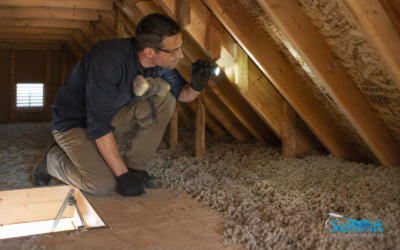
Attic access in a 1.5-storey home is also more complicated than in a standard two-storey. There are often multiple small attic spaces separated by framing, making it difficult to achieve and verify consistent insulation coverage.
Where Spray Foam Fits in 1.5-Storey Homes
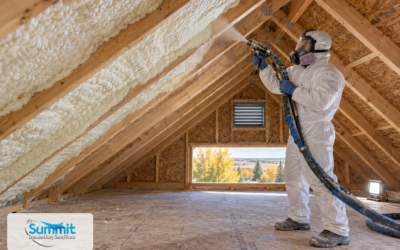
Spray foam is well-suited to the 1.5-storey form because it conforms to irregular geometry and provides both insulation and air sealing in one application. In shallow rafter bays, closed cell spray foam delivers higher thermal resistance per inch than batt alternatives, which matters when depth is limited.
At the knee walls, spray foam seals the connection between the living space and the unconditioned attic space behind it, stopping the air exchange that makes upper levels uncomfortable in both winter and summer. It can also be applied to the underside of the roof deck in the small attic areas to bring them entirely within the conditioned envelope, which simplifies the insulation challenge considerably.
Get Started on Insulating Your 1.5-Storey Home in Manitoba
If your upper level has sloped ceilings, knee walls, or rooms that are noticeably harder to heat and cool than the rest of the house, the geometry is likely working against you.
Call us to book an assessment and find out where the gaps are.